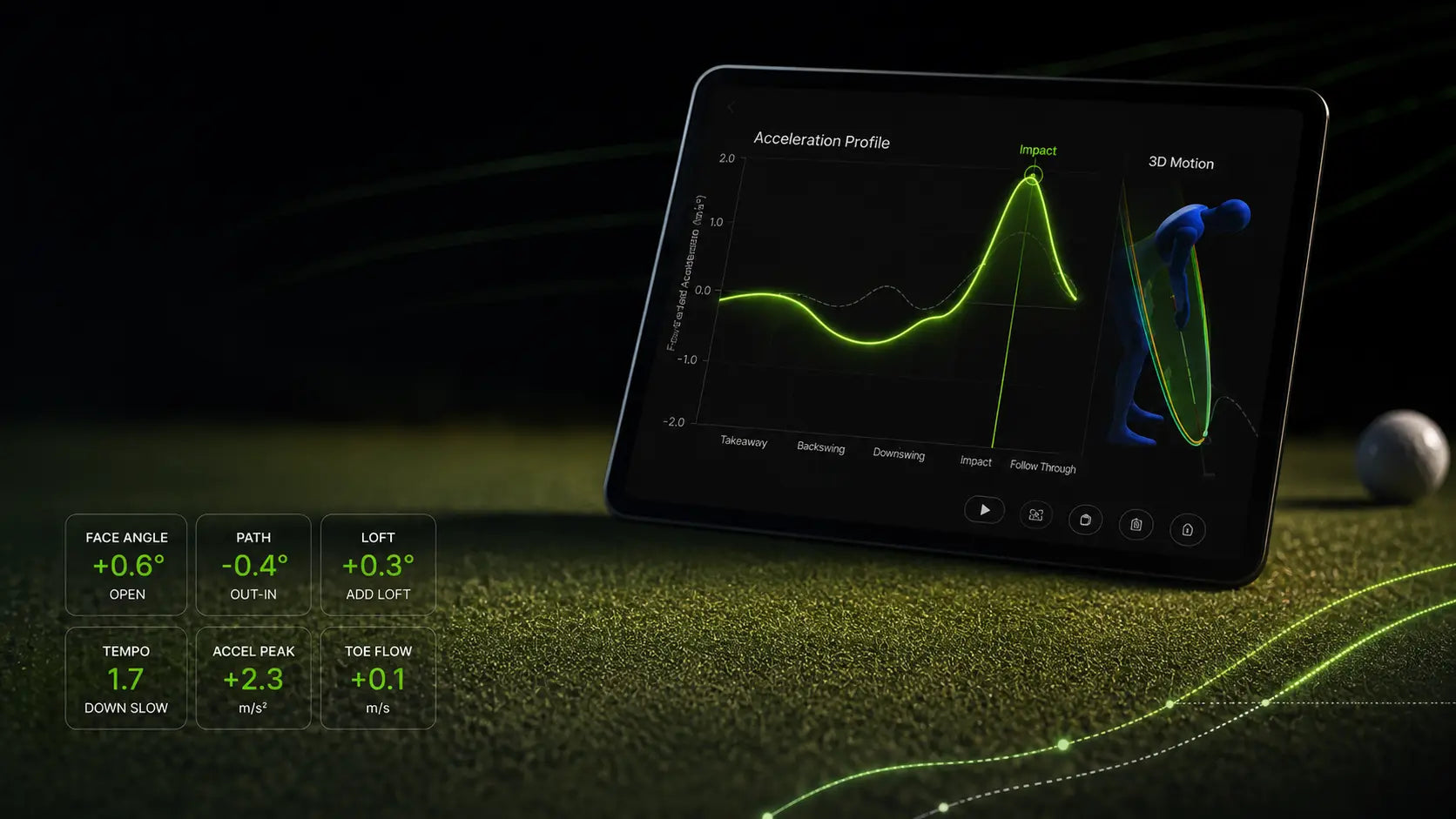
Capto Motion Analysis: The Value of the Complete Acceleration Profile
Looking beyond Capto's headline measurements
I've spent years using Capto, convinced I was overlooking something. Like many instructors, I was initially drawn to the obvious measurements. Face angle, loft, path, timing, rotation, and acceleration all provide valuable information, and much of that information translates directly to ball roll and performance.
I've discovered that some of Capto's greatest value lies beyond the headline measurements. If you've used Capto for any length of time, you probably understand why. Capto collects an enormous amount of information. That's one of its greatest strengths. It's also one of its greatest challenges. With so many measurements available, it's easy to focus on the headline values while unintentionally overlooking information that may be even more valuable. For me, the value is found in the motion data Capto records throughout the stroke. I find the motion data and the graphs and charts that can be constructed from it to be unmatched by other putting analysis tools.
Why putting acceleration matters
The way a golfer accelerates the putter matters. But how do we measure and map that acceleration? More importantly, how do we measure it in a way that's meaningful to both the instructor and the golfer?
What the Sweet Spot Target Acceleration graph reveals
One graph stands out: the Sweet Spot Target Acceleration graph. Not because it's hidden. Not because it's difficult to understand. Simply because I didn't appreciate what it's showing us. The graph reveals when acceleration is produced and the rate at which it changes throughout the putt. We get an acceleration profile for every putt. Across multiple putts, those profiles may repeat or vary significantly. That information is incredibly useful when building a more repeatable putting motion.6
Why the complete acceleration profile matters
The complete acceleration profile doesn't replace the individual measurements. It gives them context. Rather than asking how much acceleration occurred, we see how it developed. Understanding the when is arguably more important than the how much.
I've always valued Capto and the wealth of data it provides. Today, I view it as an irreplaceable teaching tool. The ability to evaluate a golfer's acceleration profile is extremely valuable to me. More importantly, it allows golfers to see when they are producing acceleration and more easily develop a quality putting motion.