Stop Guessing: The Difference Between Measured 3D Motion and Calculated Stroke Data
When evaluating putting performance, precision is everything. You need to know exactly how the putter head is moving in space. But not all data is created equal. The most critical distinction in putting technology is between measured 3D putting data and estimated, calculated data.
Understanding this difference is key to trusting the technical feedback you receive.
The Danger of Relying on Calculated Putting Metrics
Many popular analysis tools, particularly those built around radar or basic camera tracking, capture a limited set of variables (like club speed or initial ball flight) and then calculate or estimate the underlying club dynamics, such as club path or face angle.
While this can provide a reasonable estimate for a driver, putting demands millimetre accuracy. Calculated data can be prone to errors, especially when:
- Impact is Off-Centre: Off-centre strikes introduce gear effect and twist, making the estimated path unreliable.
- Movement is Subtle: The putting stroke is too subtle for remote sensors to track accurately across the entire three-dimensional arc.
If the system can't directly see or sense the club's precise movement at every moment, it's making a sophisticated guess.
The Unquestionable Power of Measured 3D Motion
Professional-grade putting analysis relies on measured 3D putting data captured directly at the source—the putter shaft—using highly advanced internal sensors.
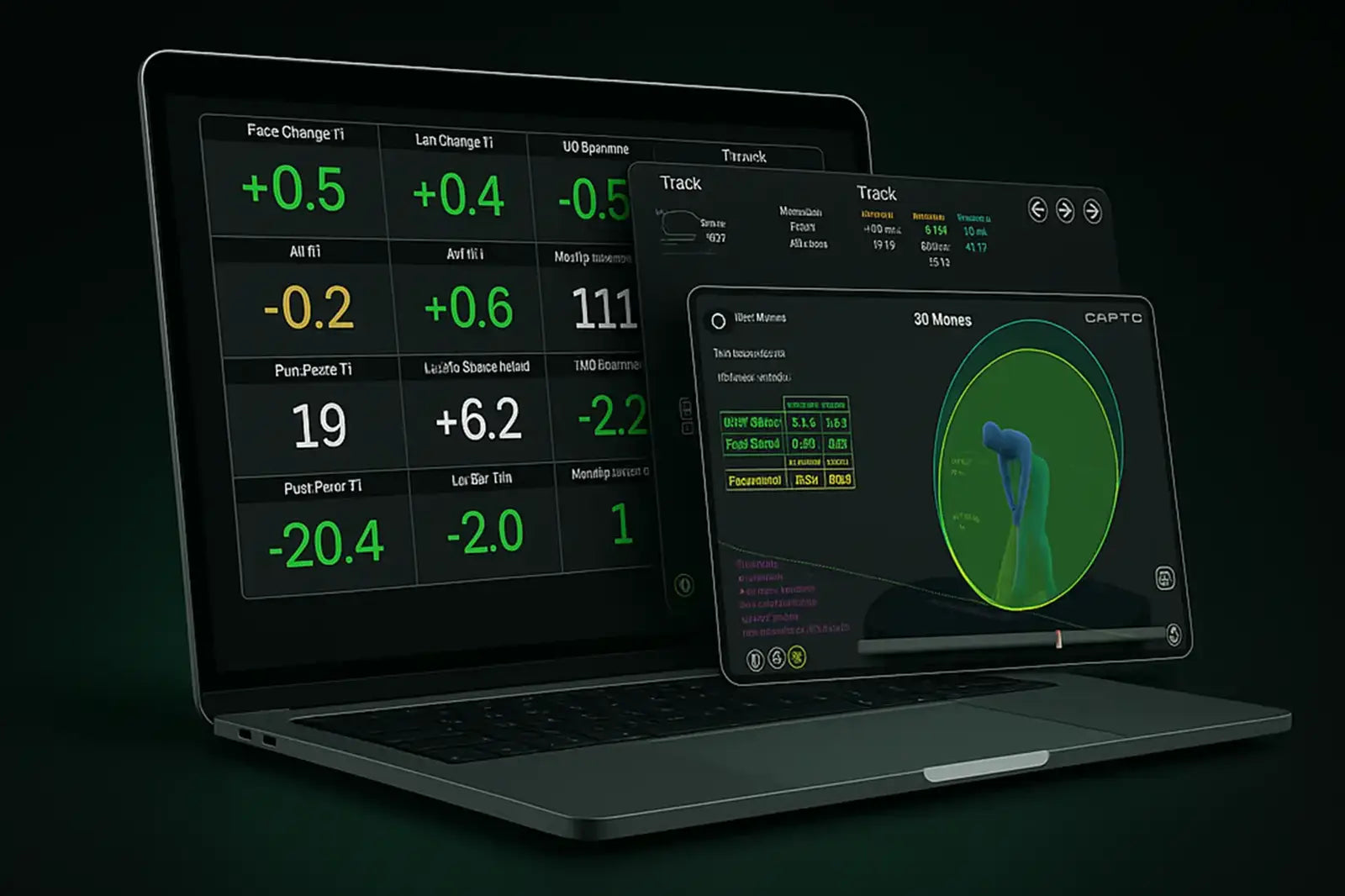
A device equipped with a high-frequency internal inertial sensor array, such as Capto, measures the putter head's velocity, rotation, and tilt along three axes (3D motion) at hundreds of frames per second. This process yields:
- True Path and Face Angle: These metrics are measured directly from the sensor's position, eliminating estimation errors caused by impact location or external factors.
- Full Stroke Visualisation: The entire movement—from the moment the club starts back to the follow-through—is recorded in 3D motion, allowing coaches to identify patterns and flaws far before impact.
- Consistency Assurance: Because the measurement system is attached to the club, the data is entirely consistent, independent of the putting surface, lighting, or room setup.
For the coach seeking to change a player's stroke mechanics, measured 3D putting data provides the scientific certainty needed to make reliable adjustments. When the movement is measured, not calculated, the data is unquestionable.